The Man Who Kept Us Alive: Patriarch Estephan Doueihy
There is a kind of person history tends to forget. Not the conqueror, not the king, but the one who quietly holds a people together while everything around them is falling apart. Estephan Doueihy was that kind of person.
He was born on August 2, 1630, in Ehden, that village carved into the northern mountains of Lebanon like something that refused to be erased. His father died when he was three. His mother raised him under Ottoman rule, in a world of heavy taxes, scattered churches, and a Christian community that was slowly being worn down. And yet by the time he was eleven, his mind had already made him impossible to ignore. The leaders of the Maronite Church sent him to Rome, to the College founded by Pope Gregory XIII, where he spent fourteen years learning everything the Latin world had to offer: philosophy, theology, Greek, Hebrew, Syriac, Latin, Italian. His professor there reportedly said he had taught across the universities of Europe and never encountered a mind like his.
He came back to Lebanon in 1655 not as a scholar seeking comfort but as a man with a purpose. He opened schools. He preached in Arabic. He travelled to Aleppo, then back to the mountain villages, then to Aleppo again. Ordained priest, then appointed Bishop of the long-neglected Diocese of Cyprus, then in 1670, at only forty years old, elected Patriarch of the Maronite Church.
The thirty-four years that followed were, by any honest measure, very hard. The Ottomans harassed him without rest. He was forced to flee his see at Qannubine nine times, hiding in caves and crumbling monasteries, carrying his manuscripts on his back. He was physically assaulted. He watched villages emptied by taxation, priests arrested, his community torn apart from within as much as from without. There was, as one cardinal noted at his beatification in 2024, not a single day of peace.
And yet he kept writing.
This is the detail that stays with you. That a man fleeing for his life, moving from one damp refuge to the next, would sit down and write history. Not because anyone asked him to, but because he understood something most people in crisis do not: a people who lose their memory lose themselves. The Maronites had very little written down. Their past existed in scattered manuscripts, in marginal notes on old books, in stories that could vanish with a single generation. Doueihy had spent his years in Rome copying everything he could find about his people in the libraries there. He gathered documents across Cyprus and Aleppo and the Lebanese mountains. Then he organized it all, shaped it, and wrote it down, more than thirty books in total, seven of them purely historical.
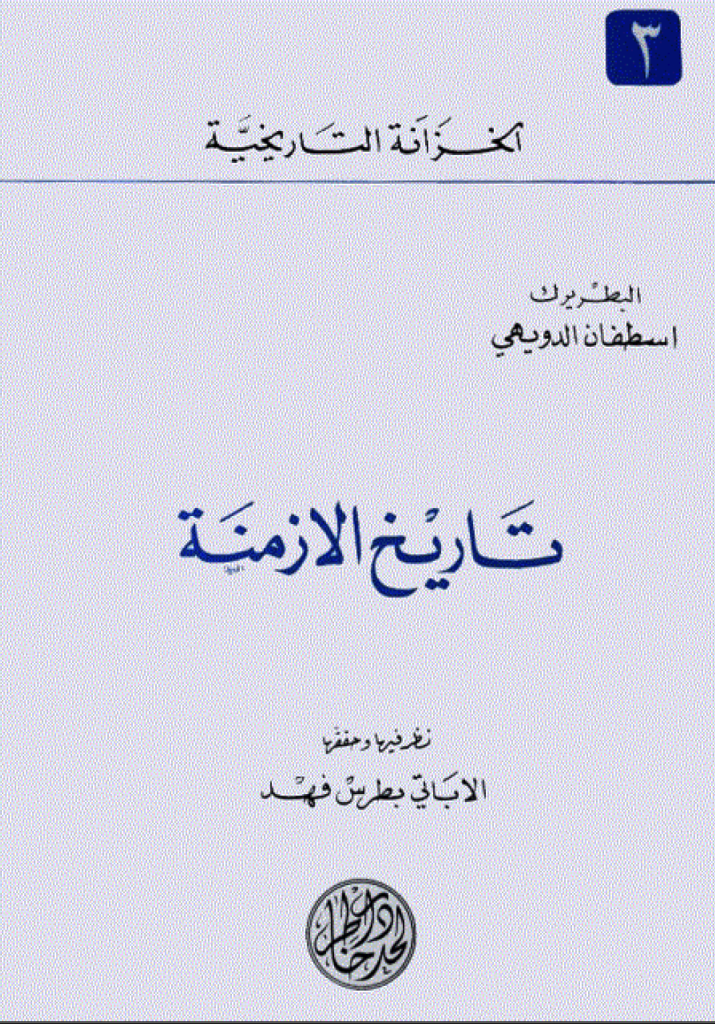
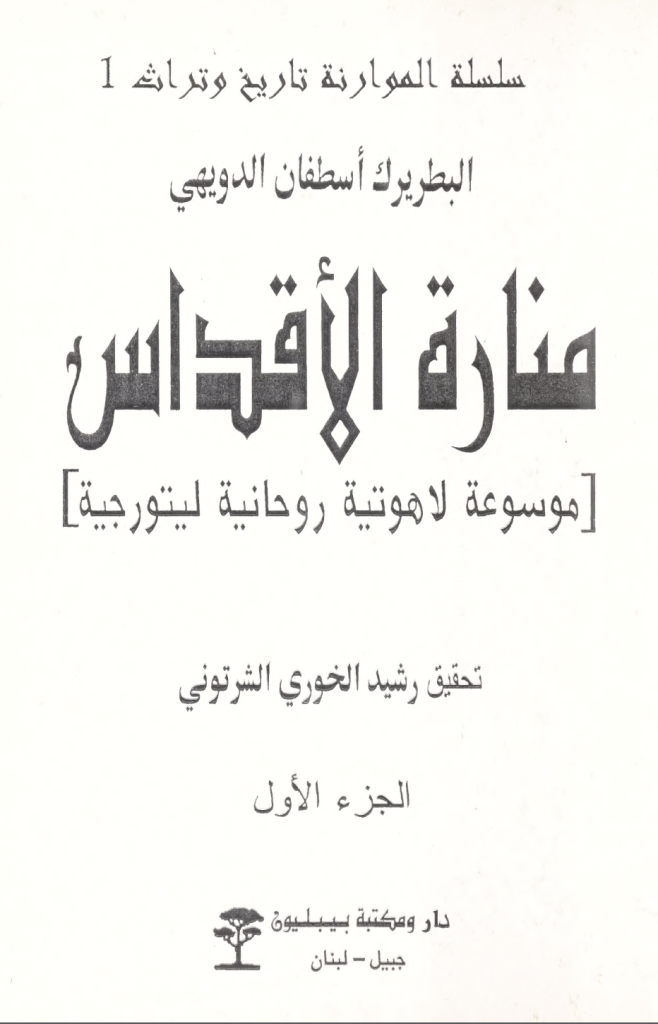
His greatest work, Tārīkh al-Azminah, the History of the Ages, stretches from the Islamic conquests of the seventh century all the way to his own time. It is the cornerstone of Maronite historiography. Without it, our knowledge of those centuries would be full of holes no amount of later scholarship could fill. He also wrote a full history of the Maronite community, a two-volume theological and liturgical encyclopedia called Manārat al-Aqdās, treatises on Syriac poetry and music, lives of the saints, a Syriac-Arabic dictionary. The list is extraordinary for any scholar. For a man who spent his patriarchate in hiding, it is almost beyond explanation.
What made Doueihy precious to his people was not only his learning. It was his stubbornness. He refused to accept that the Maronites were a community to be slowly taxed and pressured into insignificance. He wrote in Arabic at a time when the language itself was under pressure. He resisted the Latinization of Maronite rites, insisting on the distinctly Eastern, Syriac character of Maronite worship. He was not interested in becoming a pale copy of the Latin church. He wanted the Maronites to know who they were, their liturgy, their roots, their history, and to carry that knowledge with dignity.
He died on May 3, 1704, in Qannubine, in the Kadisha Valley, where seventeen other Maronite patriarchs before him had also lived and died in difficult times. People began venerating him as a saint almost immediately. It took the Church three more centuries to make it official. He was beatified on August 2, 2024, his own birthday, at a ceremony in Bkerké that brought thousands together. A long time coming, but perhaps that is how it goes with the quiet ones.
For us today, Doueihy is not simply a figure to admire from a distance. He is, in a real sense, the reason we still have a coherent Maronite identity to speak of. Every time we celebrate our liturgy in its Syriac roots, we are receiving something he fought to preserve. Every time a historian opens a book about the Maronites of the seventeenth century, they are standing on ground he built alone, in flight, by candlelight.
Lebanon is not having an easy time of it right now. It rarely has. But the mountain has seen worse, and it has always produced people who refused to let the worst be the final word. Estephan Doueihy was one of those people. That is worth remembering.
Books by P. Estephan El Douaihy
Free PDFs