
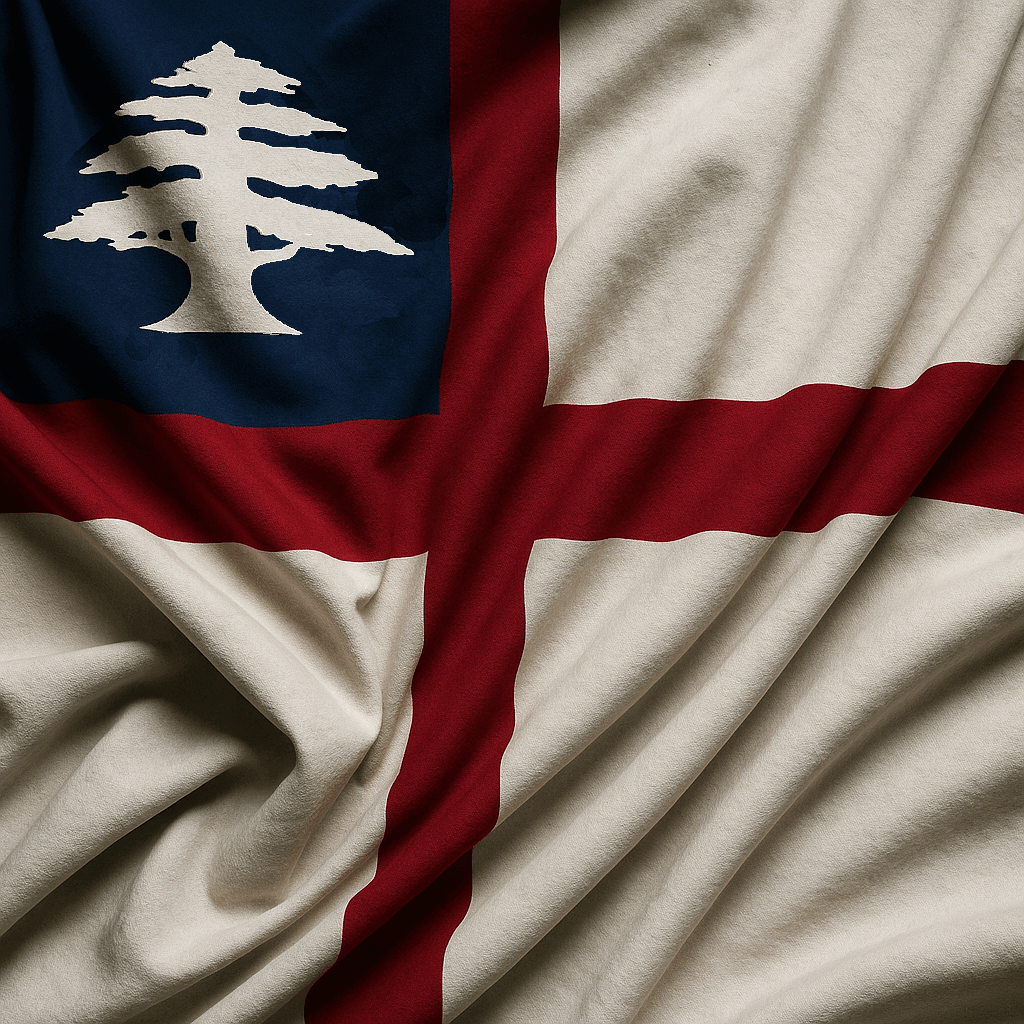
The Standard of Mount Lebanon
Our flag was first inspired by Dr. Amine Iskandar, then refined by Mario Dayba and the team to express clearly who we are as a people and what we are declaring for Mount Lebanon. Every color, every line, every choice has a reason. Below, we explain the symbolism, the history behind each element, and why this flag is not just a design but a statement of identity and future. You can download the flag in different formats.
Download the flag
1. The Red Cross of Martyrdom and Defense
The red cross is directly drawn from the traditional banner of Saint George: a bold red cross carried by Christian soldiers and protectors since the medieval period, used as a sign of courage, sacrifice, and willingness to defend the faithful even to death. Historically, the red cross on a pale field was worn in battle as a mark of holy service and martyrdom.
In our flag, that same cross is not thin or decorative. It’s heavy, wide, and dominant. It says openly: we are a people under the Cross, and we will not apologize for being Christian.
2. The Off-Center Cross: A Christian Polity, Not Just a Territory
The cross sits off-center, shifted toward the hoist (the flagpole side), instead of being placed in the mathematical middle. This “displaced cross” layout is a known Christian flag tradition: a long horizontal bar and a vertical bar pushed toward the pole, rather than a perfect plus sign in the center. That layout historically signals a specifically Christian identity and often a distinct community that governs itself.
For us, pushing the cross left has layered meaning:
- The faith stands as a shield at the front of the nation, not floating abstractly in the middle.
- Authority and legitimacy are anchored close to the heart of the flag, where you would hold it, not where the wind blows it.
- It declares political identity (a Christian state with its own order), not just geography.
3. The Canton: Our Badge of Sovereignty
The vertical arm of the cross creates a blue canton in the upper-left. In vexillology, the canton (the block in the top-left) is traditionally where a sovereign mark or founding seal is placed on an ensign.
We place the cedar there, not as decoration, but as our seal. The message is: Mount Lebanon is not just land, it is a consecrated homeland under a specific people, with a specific lineage and memory.
4. The Blue Field: The Mother, the Sea, the Promise
The blue in the canton carries two deliberate readings.
- Marian Blue: For nearly a thousand years, Christian art clothes the Virgin Mary in deep blue, originally ultramarine, a pigment once more valuable than gold. Blue became her color: purity, queenship, protection, intercession. This tradition began in Byzantine and medieval iconography, where blue marked Mary as Theotokos (God-bearer) and even “empress.”
- The Mediterranean frontier: That same blue also represents the sea that touches Mount Lebanon. The coast has always been our contact with the outside world — trade, exile, refuge, return. The flag ties our mountain to our coast, our rootedness to our horizon.
5. Red + Blue = Purple: Memory of Phoenicia
When you place our red and our blue together, you get purple — and purple in our part of the world is not random. Ancient coastal cities in historic Phoenicia produced a famous purple dye (Tyrian purple) from sea snails. That dye was so difficult and costly to make that it became the color of power, rank, and statehood for millennia.
By using deep red and deep blue, and letting them touch, we echo that inheritance: a people on this coast who were known, traded, built, exported, and endured. Our flag quietly says: we are not new. We are heirs.
6. The Cedar: Ancient, Real, Not Stylized
Our cedar is based on the real, millenia profile of a Lebanese cedar. Broad crown, layered horizontal branches, thick trunk. That silhouette is intentional. It refuses the modern simplified cedar and returns to the living tree that still stands high in Mount Lebanon.
We render it in white, not green. White turns the cedar into an emblem, like a stamped seal. It also links the tree to the word “Lebanon,” which comes from the Semitic root LBN, meaning “white,” referring to the snow-bright mountains of Mount Lebanon.
So the white cedar is literally “Lebanon” in the oldest sense: the white mountain and the people of that mountain.
7. Geometry and Order: The Golden Balance
Identity Statement
Taken together, the elements of the flag state three things very clearly:
- We are openly Christian. The cross is not hidden.
- We are the mountain people of Lebanon, the “white mountain,” marked by the cedar.
- We inherit a civilization on the Mediterranean that dealt in sacred colors and refused to disappear.
This is not just a banner. It is a claim of continuity, territory, culture, faith, and survival.